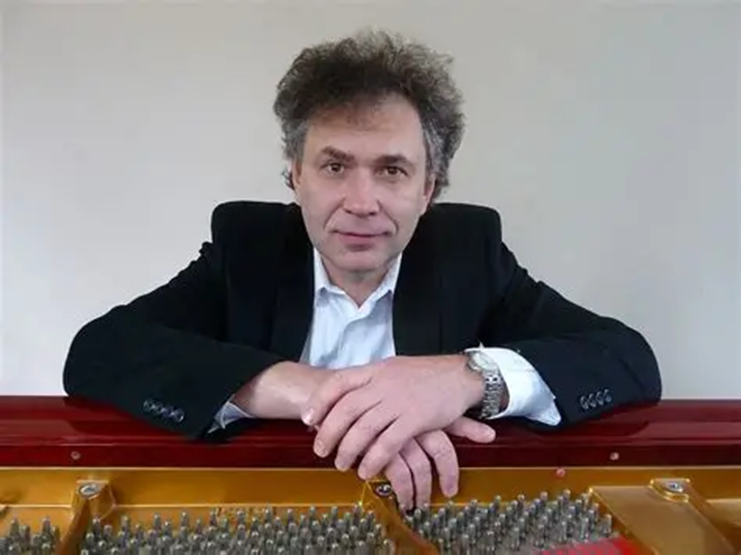
Taras Filenko, born in Zaporizhzhia, Ukraine, is an ethnomusicologist, writer, lecturer, musician, organist and concert pianist most renowned for his research and proliferation of Ukrainian music history of 19th and early 20th centuries. He has taken up the banner of cultural diplomacy to help defend the country of his birth from cultural annihilation.
Following the full-scale Russian invasion of sovereign Ukraine, Dr. Filenko has been traveling the world lending his talents at various lectures and concerts, raising awareness of Ukrainian culture, and raising funds for humanitarian aid. He focuses on the musical repertoire of Ukrainian composers and educating on the history of Ukrainian musical culture
Taras’ work echoes the efforts of the first large-scale project of Ukrainian cultural diplomacy authorized by Symon Petliura, head of the highest governing body of the restored Ukrainian state shortly after World War I. In early 1919, when Ukraine’s pleas for recognition were falling on largely deaf ears, it dispatched not only diplomats to Europe, but also a choir. Led by conductor Oleksandr Koshyts, the Ukrainian Republican Capella became an unexpected yet powerful instrument of cultural diplomacy. Its greatest triumph was Shchedryk, arranged by composer Mykola Leontovych — a song that would later cross the ocean and reemerge as the world-famous Carol of the Bells.
In a world often dominated by headlines of conflict and division, an increasingly powerful force is working behind the scenes to shape global perceptions: culture. Through films, art, language, and shared traditions, cultural diplomacy offers a means of communication that transcends politics. It is a form of public diplomacy that allows countries to engage not by coercion or trade deals, but through mutual respect and storytelling.
Cultural diplomacy is the strategic use of cultural assets—such as arts, education, and heritage—to foster mutual understanding between nations. Culture stands out among the three pillars of soft power—political values, foreign policy, and culture—because it is the most accessible. Unlike political values that may clash or foreign policy that often involves rigid negotiations, culture speaks to the heart. From academic exchange programs to culinary festivals, these touchpoints of interaction forge connections that formal diplomacy cannot.
As Russian disinformation spreads through well financed and sophisticated methods, and political and diplomatic efforts fail to stop the war on a sovereign nation, artists such as Dr. Filenko work through embassies and consulates in countries throughout the world to educate and to counter mistruths. Through music.
Dr. Filenko has performed concerts throughout the US, Armenia, Columbia, Georgia, India, Malaysia, Mexico, and the Philippines and most recently heading to Africa for a six-country tour over six weeks from February 7 – March 20, 2026.
His programs feature Ukrainian classical composers Lev Revutsky, Dmytro Bortniansky, Yakiv Stepovy, Vasyl Barvinsky, Myroslav Skory, and others, interspersing historical background, stories of brutal repression of artistic and other freedoms.
Dr. Filenko’s findings are presented in his Ph.D. dissertation from the Tchaikovsky National Music Academy of Ukraine (1989), his second Ph.D. in Ethnomusicology from University of Pittsburgh (1998), and The World of Mykola Lysenko book in English (2000) and Ukrainian (2009). As a two-time recipient of the Fulbright Scholarship, Dr. Filenko has conducted lectures and developed courses at academic institutions throughout Europe and North America focused on the classical and ethnic musical culture of Eastern Europe.
Dr. Filenko studied music in Kyiv, Donetsk, Moscow, and Pittsburgh. He was awarded a degree for music specializing in piano performance in 1982, followed in 1989 by an advanced degree (doctorate/Kandydat Nauk), in the history of music from the National Academy of Music of Ukraine (Kyiv Conservatory of Music). Filenko earned a second doctorate in ethnomusicology from the University of Pittsburgh in 1998.